
Peer Review Process
JSIA uses double-blind peer review. Authors don't know who reviewed their work, and reviewers don't know who wrote it. Every original research article, review, systematic review, case report, case series and short communication is reviewed by at least two independent external reviewers. Editorials and letters to the editor are assessed by the editors, who may also send them for external review.
Stages and timelines
Stage | What happens | Target time |
|---|---|---|
1. Technical check | The editorial office checks that all files are present, the manuscript is anonymised and the declarations are complete | Within 7 days of submission (stages 1 and 2 together) |
2. Editorial screening | The editor checks scope, originality, methods, ethics approval and trial registration, and reviews the similarity report. Unsuitable manuscripts are declined at this stage, with reasons | Within 7 days of submission (stages 1 and 2 together) |
3. Reviewer invitation | The handling editor invites at least two external reviewers with expertise in the topic | Usually within 1 week |
4. Peer review | Reviewers assess the manuscript and send a report with a recommendation | 21 days per reviewer |
5. First decision | The editor weighs the reports and decides. If the reports conflict, a third reviewer may be invited | About 6 weeks after submission |
6. Revision | Authors return a revised manuscript with a point-by-point response. Major revisions usually go back to the same reviewers | Minor revisions: 14 days. Major revisions: 30 days |
7. Final decision | The editor accepts or rejects the revised manuscript. Accepted authors receive an acceptance letter and the APC invoice | Usually within 2 weeks of resubmission |
8. Production | Copy-editing, typesetting and proofs, then online publication with a Crossref DOI | Proofs returned within 3 days |
Authors who need more time for a revision should ask the editorial office before the deadline.
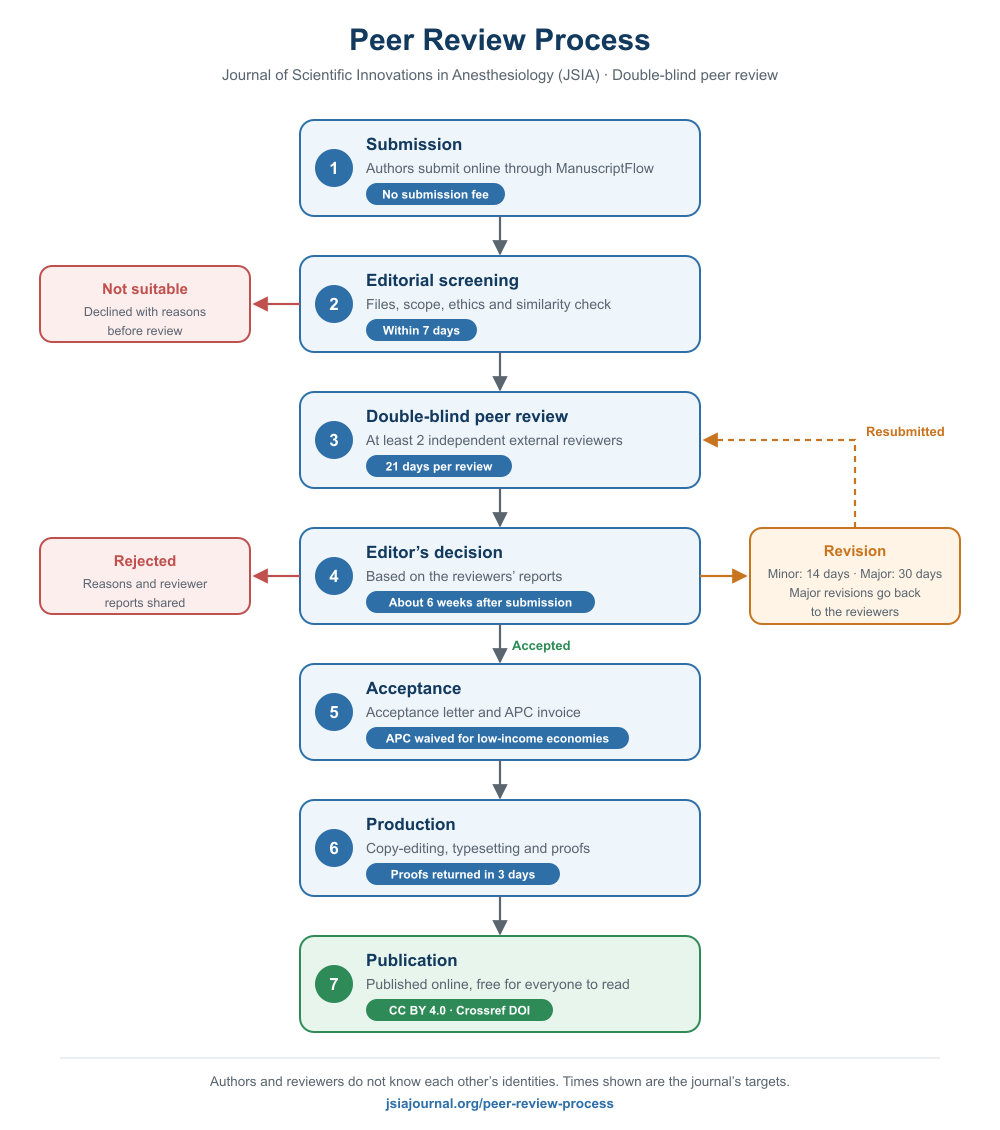
Possible decisions
Accept, with no further changes
Minor revision: small changes. Usually checked by the editor
Major revision: substantial changes. Usually sent back to the reviewers
Reject: the manuscript is not suitable for JSIA, and the reasons are given
How reviewers are chosen
Reviewers are chosen for their subject expertise and publication record. They must have no conflict of interest: no shared institution, collaboration or co-authorship with any author in the past 3 years, and no financial interest in the work. Authors may suggest reviewers, but at least one reviewer of every manuscript is chosen independently by the editor.
Confidentiality
Manuscripts and reviews are confidential. Reviewers' names are never disclosed to authors. Reviewers must not share the manuscript, contact the authors, or upload any part of the manuscript to AI tools (see the AI Policy).
Who decides
The handling editor makes the decision based on the reviewers' reports and their own reading of the manuscript. The Editor-in-Chief is responsible for every decision the journal makes. Reviewers advise; they don't decide.
Editors and board members as authors
A manuscript from an editor or board member is handled by an independent editor. The submitting member has no access to its review or decision, and only external reviewers assess it. No more than one in four research papers in any issue will have an editor or board member as an author.
Appeals
Authors may appeal a decision once, within 30 days. The full appeals process is on the Publication Ethics page.
Reviewers can find their own guidance on the Reviewer Guidelines page.
Last updated: November 2026